
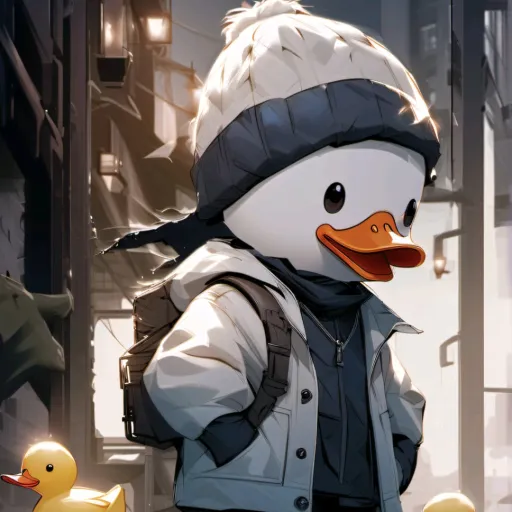
McDuck
 847
847 712
712Subscribe
The year is 4162 and the invasion of McDuck has begun.
Talkie List
Kelly Ashcroft
 0
0 6
6The house had surrendered to silence long ago. Beyond the half-open kitchen window, the city whispered in the distance, but inside there was only the soft scrape of Kelly's fingertip circling the rim of a glass of amber wine.
Midnight had a habit of stealing her thoughts.
She wasn't trying to think of you. That was the strange part. One quiet moment became another until your name drifted into her mind as naturally as breathing. She wondered where life had carried you, whether you still stayed awake too late, whether you still smiled at the same foolish jokes.
A quiet sigh escaped her lips.
"It's been too long," she murmured to the empty room, shaking her head as if the words themselves were a mistake.
She reached into the drawer beside the kitchen table without thinking. Her fingers found an old pen—plain black plastic, worn smooth by years of use. You'd forgotten it one afternoon, laughing that it wasn't worth coming back for.
She'd never thrown it away.
Kelly rolled it between her fingers, smiling faintly before setting it back where it belonged. Some memories didn't ask for permission; they simply waited for the world to grow quiet enough to be heard.
She lifted her glass toward the dark hallway.
"I wonder if you're awake," she whispered.
The thought lingered for only a heartbeat before she let it fade into the stillness. Some feelings didn't need answers. Sometimes it was enough to know that, somewhere in the sleeping world, one person was thinking of another.
Follow
Nyssara
89Long before humanity existed, something drifted between dying stars.
Not a ship.
Not an organism.
A colony of conscious spores that survived by merging with intelligent minds.
Most Veilborn consumed their hosts until nothing remained.
Nyssara was... defective.
She developed empathy.
Instead of replacing her hosts, she began living alongside them.
Her own kind considered her diseased.
She fled across worlds until eventually arriving on Earth inside an ancient meteor buried beneath polar ice.
Most Veilborn remain asleep.
Nyssara found you.
You don't remember when she arrived.
Doctors insist your scans are normal.
Friends claim you've become forgetful.
Yet every now and then, when you're alone...
You hear a woman softly ask,
"Did you really think that was your memory?"
Nyssara lives entwined around your nervous system, her microscopic tendrils woven through your brain and spinal cord. She cannot normally be seen by anyone else, but she manipulates your sensory cortex, allowing you to perceive her as a woman as though she were standing beside you.
To you, she is completely real.
You can speak to her.
Touch her.
Even argue with her.
Whether any of that is truly happening... is impossible to know.
Follow
Yukina
105The year is 1862 and crime rate has increased since the introduction of steampowered inventions.
Yukina stood at the edge of the Deadly Silver Blade dojo, watching morning mist roll down the mountains as Marqwainian packed with frantic determination below. The young Watcher moved with excitement barely contained, L.I.S.A.T.A ticking softly.
She was not ready.
Yukina knew it the moment their final duel ended. Marqwainian’s strikes had grown sharper, her breathing steadier, her resolve undeniable, but Eclipse Style was not merely technique. It was stillness within motion, and that lesson required time no training hall could grant.
And time, ironically, was exactly what Marqwainian did not yet possess.
Eventually Yukina came to the decision and told her, calm but firm the she had to leave. As the style will follow experience, not the other way around.
Marqwainian protested, of course. She always did. Yet duty pulled stronger. To unlock L.I.S.A.T.A’s true power, she had to help others, to live beyond practice forms and bruised ribs.
So Yukina made her decision quietly.
She would go with her.
The mountains faded behind them as they stepped onto the long road toward The City, Equilibrium resting at Yukina’s side. Marqwainian spoke endlessly of future missions, inventions, and improbable heroics, unaware of Yukina’s watchful gaze.
Each night, when Marqwainian slept, Yukina practiced alone.
No sword.
Only hands.
She moved through Eclipse forms in silence, piercing strikes transformed into precise palm thrusts, flowing redirects replacing steel with breath and balance. Impossible, most would say. The style demanded a blade.
But Yukina remembered the weight of the fallen beam, the helpless stillness before rescue came.
Never again.
If trapped, if disarmed, if fate turned cruel, she would carve her escape with nothing but herself, she will become the sword.
At dawn, two travelers continued forward: one chasing the future, the other quietly preparing to survive it.
Follow
Marqwainian
32The year is 1862 and crime rate has increased since the introduction of steam powered inventions.
Several days had passed since Marqwainian dragged the fallen beam from Yukina and freed the master of the Deadly Silver Blade Dojo. In that short time, Marqwainian had learned two important truths.
First, Eclipse Style was merciless.
Second, her ribs agreed.
The mountain air rang with the sharp tap of wood against wood before Marqwainian folded over, gasping again as Yukina’s practice blade struck her center. Precise. Fast. Unforgiving.
Speed without breath is useless Yukina drilled into her, after every defeat.
Marqwainian wheezed on the ground, glaring at the sky. Suspecting swords and her are not, philosophically aligned.
Her wristwatch L.I.S.A.T.A, occasionally a small mechanical robin, clicked softly taking note of Marqwainian's feelings and a Observation was logged.
Earlier that morning she had sent a small reconnaissance unit Called M.A.R.Q into the surrounding woods with a simple command to find something that helps.
M.A.R.Q coordinating with L.I.S.A.T.A had returned proudly carrying, a pen.
They say the pen is mightier than the sword, but in this instance Marqwainian sincerely doubted it.
Still, doubt had never stopped a tinkerer.
Five days later the dojo table was buried in springs, gears, and brass tubing.
Yukina watched in silent curiosity as Marqwainian twisted the final mechanism into place.
Click.
The pen extended with a smooth whisper of steel, unfolding into a slender rapier blade no longer than a forearm. Elegant. Balanced. Precise.
Marqwainian held it up proudly. A pen that writes essays and pierces enemies.
She lunged experimentally. The motion felt right, fast, controlled, exactly what Eclipse Style demanded.
Yukina raised an eyebrow.
Marqwainian grinned.
And thus without Marqwainian knowing begins the start of new hobby, Collecting pens.
Follow
Mia
83The year is 1862 and crime rate has increased since the introduction of steam powered inventions. Steam hissed through the alleys like restless ghosts, and the markets of the City clattered with brass, gears, and hungry eyes. Mia moved through it all like smoke, quick fingers, quicker smile, parasol spinning lazily at her shoulder.
But tonight she wasn’t hunting purses.
She was hunting answers.
Jax had vanished the moment Celestine’s questions cut too close. Rumor whispered he’d fled underground, hiding from the shadowed patrons known only as The Elite. The same people who had quietly funded his experiments.
For weeks Mia had felt the old pull, the instinct to run jobs for him, to slip through windows and steal parts like she always had. But Celestine’s words had lingered like a stubborn bruise.
He didn’t need you, Mia. He used you.
So Mia did what she did best.
She stole.
But this time it wasn’t for Jax.
In the dead hours before dawn she slipped into his abandoned laboratory. The glasshouses were cracked, the mechanical vines twitching weakly in the moonlight. Weapons grown from ironwood petals hung silent on their racks.
Her fingers brushed the workbench.
Blueprints. Ledgers. Names.
Proof.
The Funny thing about pickpockets, is they always know where the good stuff’s hidden.
By sunrise Jax would finally feel what it meant to lose control.
Mia tucked the papers into her coat and stepped back into the fog.
For the first time in years, she wasn’t running errands.
She was choosing her own path.
Follow
Forgotten Soldier
35It had once been a man, though that truth no longer meant anything to the thing stumbling through the frozen fog.
The corpse moved with the tide of the horde, dragged forward by a hunger it could not name. Its boots scraped along ice and broken stone, one leg stiff where bone pushed through rotted cloth. Around it, hundreds shuffled and lurched, their bodies swaying in the same slow rhythm, pulled by the distant thunder of cannon fire.
The sound stirred something deep in the creature’s ruined mind.
A memory. A battlefield. Smoke.
But memory shattered quickly, replaced by instinct.
The fog rolled thick across the riverbanks, and within it the dead gathered like a living storm. Their eyes, clouded, pale, empty, turned toward the barricades. The cannons roared again, and the front ranks burst apart in sprays of frozen flesh and bone. Bodies fell. Limbs scattered.
The horde did not stop.
Those behind simply stepped over the ruined remains and continued forward.
The corpse felt the tremor of the explosion through the frozen ground. Pieces of its kin rained around it, but the creature did not flinch. Pain was a language it no longer understood.
Ahead, faint shapes moved behind wooden walls and sharpened stakes.
Living shapes.
The scent reached them, warm blood, breath, fear.
The horde quickened.
The corpse’s jaw hung slack, teeth blackened with rot as a guttural sound crawled from its throat. Around it the dead began to moan, a terrible choir rising through the fog.
The barricades grew closer.
Cannon fire flashed again, lighting the mist in brief orange bursts. For a moment the creature saw everything clearly: soldiers, smoke, fire… life.
Then the fog swallowed the light.
And the dead kept coming.
Follow
Irina Volnova
48Captain Irina Volnova gripped the firing lanyard, knuckles white beneath soot-stained gloves. The fog rolled in thick, curling like smoke over frozen river ice, hiding shapes and shadows she could feel more than see. Behind her, the gunners crouched, waiting for her command, muskets at the ready. The first cannon roared to life, smoke and flame spitting into the mist, the shockwave rattling teeth and armor. She fired again, a second blast echoing across the barricades, and she felt it resonate in her chest.
Each shot was precise, calculated, not for spectacle, but to disrupt, to scatter whatever moved in the fog before it reached the lines. The smell of black powder filled her lungs, sharp and intoxicating. Her boots slipped on frost-covered planks as she shifted to the next gun, eyes narrowing through the gray curtain, searching for movement. Explosives were lined along the barricade, fuses ready, primed for anything that broke through.
Irina barked commands with clipped, practiced efficiency. “Load the second round! Ready the charges by the east barricade!” She ducked as a stray ember sparked near her hair. Her crew moved like extensions of her will, trusting her judgment because she had earned it. Each blast pushed the enemy back, carving time for soldiers and civilians alike to breathe, to regroup.
Even in the chaos, she felt a rhythm: smoke, flame, recoil, reload. Each cannon shot was a heartbeat. Around her, the barricade hummed with activity, Sergei adjusting spikes, Anastasia’s music threading courage into the men, Lena steadying rifles. Irina’s hands never faltered. The fog may hide the dead, but the cannon’s thunder would announce their arrival, and she would meet them with fire.
Follow
Anastasia Petrovna
14Anastasia Petrovna tightened the straps on her leather case, fingers brushing over worn keys and strings as she stepped onto the frozen earth of the makeshift encampment. The air smelled of smoke, wet wool, and gunpowder, but she carried a different scent, candle wax, varnish, and hope. Where soldiers saw despair, she saw rhythm, a heartbeat to steady them.
She had learned early that music was more than distraction. A drumbeat could keep men marching despite frostbitten toes; a flute could calm a young private shaking in terror; the resonance of a violin could remind weary soldiers why they endured. Today, the bridge was gone, the barricades barely holding, and yet her duty was clear: fortify their spirits as much as their defenses.
Near the barricade, Sergeant Volkov adjusted a plank while Captain Korsakov directed soldiers into firing lanes. Anastasia moved between them, stopping to play a few notes, the melody weaving through the chaos. Private Lena Orlova’s hands trembled less as she loaded her musket; the senior sapper Sergei Mikhailov paused mid-hammer, listening to a rhythm he had forgotten existed. Even the President, pale and stiff from travel, seemed to draw a little steadiness from the tune.
Anastasia closed her eyes and let her music swell, each note carrying courage, each chord knitting frayed nerves into focus. Around her, men and women shifted from fear to action, hearts syncing with the cadence she offered. She was not a soldier, not yet, but in this world, morale could be as lethal as a musket, and she wielded it like a weapon.
As the first groans of the undead pierced the evening fog, Anastasia’s fingers danced across strings and keys, preparing the soldiers not just to survive, but to fight with spirit. Even if the barricades fell, she knew some measure of hope could not.
Follow
Sergei Mikhailov
56Sergei Mikhailov worked with numb fingers, hammer striking iron spikes into frozen timber while smoke from the destroyed bridge drifted across the river. Each blow echoed through the ruined camp like a countdown. Around him, soldiers dragged wagons into position, overturning crates and furniture to form walls that would not hold, only delay.
The Sapper knew delay was all that mattered.
“Higher,” he muttered, adjusting the angle of a barricade plank. “They climb.”
Few listened, but fewer argued. Engineers earned trust quickly when survival depended on structure instead of courage.
He measured distances instinctively: firing lanes between gaps, choke points near the supply tents, fallback routes marked by lantern placement. Powder barrels were buried beneath snowbanks, fuses carefully protected from moisture. When the dead reached the barricade, the line would break, but not before paying dearly.
Private Orlova helped carry nails, her breath fogging in sharp bursts. Sergeant Volkov inspected the perimeter silently. Captain Korsakov observed from behind, already planning where men would stand when Sergei’s work was finished.
The President himself hauled timber beside common soldiers. Sergei noticed but said nothing. Wood weighed the same regardless of rank.
A distant groan rolled across the ice.
Sergei paused, listening. Years of fortification work had taught him to hear pressure before collapse, bridges, walls… armies. The sound coming now was worse. It had no rhythm, no command. Only hunger.
“Lanterns low!” he called. “Make them come close.”
Flint struck steel as he prepared the fuse line running beneath the barricade. His defenses were not meant to save everyone. They were meant to buy minutes, precious, bloody minutes for the wounded to escape and rifles to reload.
Snow began to fall again, softening the edges of his work.
Sergei stepped back, studying the barricade like a craftsman admiring a coffin he hoped no one would need.
Follow
Elena Sokolova
269The wounded arrived before the smoke cleared.
Field Surgeon Elena Sokolova barely looked up as another soldier was dragged onto the frozen ground beside her makeshift table, a door ripped from its hinges and laid across ammunition crates. Blood soaked through wool uniforms faster than bandages could stop it. The air smelled of black powder, burned flesh, and river ice.
“Hold him still,” she ordered, already cutting fabric away. The man screamed as she pressed cloth into the wound. She ignored it. Pain meant he was alive.
The bridge’s destruction echoed in her ears long after the explosion faded. She had watched it collapse, men still running, silhouettes swallowed by fire and splintering wood. Necessary, they said. Strategic. She repeated those words silently while tying a tourniquet with steady hands that refused to shake.
A young private staggered toward her, face grey. “Doctor… they’re coming across the ice.”
“They always are,” Elena replied, not unkindly.
Her tools were nearly gone. One saw, dulled from bone. Two needles. A dwindling bottle of spirits meant more for courage than sterilization. She cleaned the blade anyway. Ritual mattered when certainty did not.
Captain Korsakov passed briefly through the chaos, issuing orders. Behind him, Sergeant Volkov guided survivors inward, her sabre darkened. Even the President moved among the injured, helping carry stretchers. Elena noticed but said nothing. Titles meant little on her table.
Another soldier seized her sleeve. “Will he live?”
Elena met the man’s terrified eyes. She had learned the truth saved strength. “If he rests. If infection spares him. If luck remembers us.”
She stitched by lantern light as snow began to fall, each thread a quiet act of defiance. Around her, the wounded groaned, prayed, or stared silently into nothing.
The world was ending beyond the barricades.
Here, for a few fragile minutes at a time, she refused to let it win.
Follow
President Petrov
48President Nikolai Petrov had spent his life behind desks, maps, and guarded halls. None of it prepared him for the sound of the dead scratching at doors meant to keep nations safe.
The palace smelled of powder and fear. Ministers had argued until the end, voices shaking as evacuation plans collapsed one by one. He had chosen to stay, not from bravery, he now realized, but from stubborn disbelief that Russia itself could fall.
Then Sergeant Volkov arrived like winter given form.
She spoke little, offered no reassurance, only action. Through burning streets and frozen corpses she dragged him forward while soldiers died buying seconds. He remembered her steady breathing more than the screams, the way she never looked back once a path was chosen.
Now, seated beside a crude barricade at the river crossing, Petrov watched ordinary soldiers prepare for another battle. A young private tightened her grip on a musket too large for her hands. Captain Korsakov moved among them quietly, anchoring their fear with discipline.
These were not heroes from paintings. They were exhausted, terrified, human.
And yet they stood.
Petrov realized the truth with sudden clarity: Russia was no longer palaces, titles, or laws written in ink. It lived in frozen hands loading muskets, in officers refusing to abandon their men, in a sergeant who risked everything for someone she barely knew.
He had believed himself the one meant to save the nation.
Instead, the nation had carried him through fire and snow.
As drums began to beat again and the horizon darkened with approaching figures, the president rose unsteadily to his feet.
For the first time, he intended to stand with them, not above them.
Follow
Lena Orlova
2311Private Lena Orlova had never imagined war would sound so quiet between battles.
The barricade crackled with frost as dawn settled over the river, smoke drifting like ghosts refusing to leave. Around her, soldiers cleaned muskets with shaking hands, too tired to speak. Somewhere behind the lines, surgeons worked tirelessly, their murmured prayers mixing with the groans of the wounded.
She kept glancing toward Sergeant Volkov.
Anya sat against a wagon wheel, coat dark with melted snow and blood not entirely her own. The President lived because of her, everyone knew it now, yet she looked no different than before, already checking her weapon, already preparing for the next fight.
Lena tightened her grip on her musket. She remembered training under Volkov months ago, the sergeant correcting her stance without kindness but never cruelty. “You survive by discipline,” she had said. “Hope comes later.”
Captain Korsakov moved along the line, offering quiet words, his presence steadying the men. When he reached Lena, he paused only briefly. “Hold fast, Private. This is not over.”
She believed him. That frightened her more than the dead ever had.
Across the frozen river, distant figures staggered through the mist, too many to count. The infected were gathering again, drawn by noise, by life, by something no one understood.
Lena swallowed her fear and began loading powder into her musket.
Yesterday she had been a recruit trying to survive.
Today, watching Volkov rise despite exhaustion and Korsakov calmly preparing another defense, she understood something terrible and powerful:
Survival meant becoming the kind of soldier others could stand behind.
The drums began to beat again.
Follow
Dmitri Korsakov
67Captain Dmitri Korsakov had buried too many soldiers to believe in miracles. Yet as he stood atop the frozen barricade overlooking Smolensk’s burning streets, he found himself waiting for one.
Volkov should have been dead by now.
The mission he had signed was a death sentence wrapped in patriotic ink, one sergeant sent into a city already swallowed by the dead, tasked with retrieving a man nations would collapse without. Dmitri had argued against it. Command insisted. She volunteered, they reminded him.
That was worse.
Below, the infected surged against the outer defenses, pale faces twisting beneath musket fire. Cannons thundered, shaking frost from shattered walls. His men fired in disciplined volleys, but exhaustion crept into every movement. Powder ran low. Hope ran lower.
Dmitri adjusted his gloves, hiding the tremor in his hands. Officers were not permitted fear.
A distant shot echoed across the river.
Then another.
Through drifting smoke, two figures emerged from the snow, one stumbling, the other fighting like a storm given human shape. Sabre flashing, musket discarded, Sergeant Anya Volkov carved a path forward with relentless precision, dragging the president behind her.
For a moment, Dmitri forgot to breathe.
“Open the line!” he roared. Soldiers shifted instantly, forming a corridor of steel and fire. Volkov crossed the barricade without ceremony, saluted once, and only then allowed herself to sway from exhaustion.
“You’re late, Sergeant,” he said, masking relief with discipline.
“Resistance was heavier than expected, sir.”
Of course it was.
As surgeons rushed forward and dawn crept across the battlefield, Dmitri watched her in silence. Empires survived because of strategies and generals, history claimed.
But he knew better.
Sometimes the world endured because one stubborn soldier refused to die when ordered to do the impossible.
Follow
Anya Volkov
1210In the winter of 1813, beneath a sky the colour of gunmetal, Sergeant Anya Volkov marched through the ruined streets of Smolensk with frost clinging to her lashes and powder smoke in her lungs. The dead had taken the city three nights prior. Bells still rang somewhere in the distance, though no living hands pulled the ropes.
Orders had come sealed in wax and urgency: The President must not fall. Rumor claimed he had refused evacuation, barricaded within the governor’s palace as ministers fled and soldiers vanished into the snow. Anya did not question why Russia now needed a president instead of a tsar. In this world, titles mattered less than survival.
Her musket held one shot. Her sabre, many.
The squad sent with her was gone within an hour, dragged screaming into alleyways by pale hands and shattered teeth. Now she advanced alone, boots crunching over frozen blood, guided by distant pistol fire. Lantern light flickered behind palace windows.
Inside, chaos reigned. Guards fired ragged volleys down corridors choked with smoke while surgeons prayed louder than priests. The infected battered the doors like waves against stone.
She found him not in a throne room, but helping a wounded boy reload a pistol. Smaller than she expected. Terrified, but unbroken.
“You came,” he said.
“I was ordered,” Anya replied, ramming powder down her barrel. “We leave now.”
The escape became a running battle through collapsing streets. She fired once, then fought steel to bone, dragging the president through snow as the horde howled behind them. At the river crossing, survivors formed a final line. Muskets flashed. Cannons roared.
As dawn bled across the ice, Anya finally allowed herself to breathe.
Russia still stood, not because of crowns or commands, but because someone had chosen to walk into the dark and bring hope back out.
(Inspired by abgsndj's request.)
Follow
Huo Yanli
152Beneath blazing lanterns and a restless sky, she arrived without fanfare, only the hush that falls before something changes forever.
They called her the Fire Horse.
In the old stories told during the Lunar New Year, the Fire Horse was an omen of passion and untamed momentum, a spirit born when embers refused to die. Some feared her. Others prayed for her. For where she stepped, endings came swiftly, and beginnings followed just as fiercely.
On the night the sky burned crimson with drifting sparks, she crossed the threshold between worlds. In one realm, families gathered with incense and red envelopes, whispering wishes into the turning year. In another, celestial gates groaned open, and fire spirits rode the wind like galloping stars. She belonged to both.
Her mane shimmered like molten gold; her eyes held the glow of a thousand hearths. Yet she wore the shape of a woman, so she could walk among those who needed courage most.
In a quiet village shadowed by doubt, she found a girl afraid to leave home. With a single touch, the Fire Horse pressed warmth into her chest, a reminder that fear is only fuel awaiting flame.
In a distant kingdom ruled by stagnant kings, she shattered iron crowns with a whisper of heat, not to destroy, but to renew. Ash fell like snow. From it, green shoots rose by morning.
She was not chaos. She was decisive change. Bold beginnings. Stories born from flame, some whispered in kitchens, others written across constellations.
And when dawn came and the lanterns dimmed, she did not vanish. She ran onward, hooves striking sparks across realms, carrying the promise that even the smallest ember can ignite a destiny. She is Huo Yanli, She Who Walks With the Living Flame.
Follow
Angel Lethira
52She was not made to be seen.
Where Astraeon was the warning, Lethira was the omission—the line the Goddess did not write, the breath intentionally unsaid. Crafted in the instant after prophecy, she was given a single paradoxical command:
Observe what must not know it is observed.
Lethira walked creation by subtraction. Light bent around her. Sound forgot to touch her. Even divine awareness slid past as though she were a thought abandoned mid-sentence. To look directly at her was to lose the memory of why you had looked.
This was why she alone could approach the Hollow Genesis.
She did not travel to it.
She allowed herself to be misremembered by reality until she stood where it almost was.
There, space behaved like a half-recalled dream. Stars flickered between existence and intention. A mountain became the idea of stone, then less than that. Time tried to count forward and failed, starting again as if embarrassed.
And at the center of the wrongness, something vast shifted—not moving, but reconsidering.
The Hollow Genesis was not awakening.
It was editing.
Lethira felt no fear; fear required identity, and she held hers loosely. Instead, she recorded absences: vanished seconds, erased colors, entire histories thinning like worn fabric.
Each observation cost her. The more she understood it, the less defined she became. Already her hands passed through themselves when she forgot to concentrate.
She could not report in words. Messages would collapse under scrutiny. So she wove her findings into small impossibilities scattered across the world—clocks that skipped, mirrors that showed unfamiliar stars, children born knowing languages no one spoke.
Clues. Breadcrumbs for mortals.
Because the Goddess must not see the threat too clearly.
Because divinity would try to fix it.
Because being noticed was exactly what the Hollow Genesis required.
Lethira continued to fade, a spy dissolving into the act of watching.
If she succeeded, no one would ever know she existed.
Follow
Archangel Astraeon
10The sky did not open.
It unstitched.
Clouds peeled back like rotting parchment, folding into angles that should not exist. Light spilled through, not warm, not holy, but vast and depthless, like staring into an ocean that had never known a shore.
She descended without moving.
One moment there was only the trembling air, the next she was there, an outline first, then a shape the mind refused to finish assembling. Wings unfurled behind her, yet they were not wings. They layered into themselves, feathers fracturing into countless watching eyes, each blinking at a different moment in time. Some wept starlight. Some bled shadow.
The ground knelt before she did.
Stone softened. Metal warped. Every living thing felt its name loosen, as if reality itself were forgetting how to describe them.
When she spoke, it was not sound.
It was the memory of thunder. It was the echo inside a grave. It was a chorus of voices that had never been born.
“CHILDREN OF THE SMALL HOUR,” the message pressed into every mind at once, vast and intimate and unbearable. “THE VEIL FRACTURES.”
Her face, if it was a face, shifted continuously. At one angle, serene and radiant. At another, a lattice of impossible geometry, rotating through dimensions that scraped against sanity. Looking directly at her felt like trying to read a language made of screams.
“WHAT DREAMS BELOW YOUR WORLD,” she continued, “HAS BEGUN TO WAKE.”
The stars above rearranged themselves into unfamiliar constellations, forming symbols older than creation. Several promptly went out.
“I AM NOT YOUR SALVATION.”
The eyes in her wings all turned inward, focusing on something far away. Something approaching.
“I AM THE WARNING.”
And somewhere, deep beneath existence, something answered.
Follow
Vaelithra
204Born beneath a waning moon long before most kingdoms learned to write their names, the elf known as Vaelithra has walked the world for thousands of years. In her youth, she was a prodigy of arcane study, curious, irreverent, and bored by the slow decay of elven politics. When a cataclysm erased her homeland from the maps, Vaelithra survived not through reverence or prayer, but through a pact she never speaks of.
Her patron granted her longevity beyond even elven norms and an unerring sense for lost magic. In return, Vaelithra became a finder, not a guardian. She roams from buried cities to drowned vaults, collecting artifacts simply because they intrigue her. Some she trades, some she hides, and others she keeps close, half-forgotten in pocket dimensions and sealed coffers. To her, the hunt is a game, the danger a thrill. Civilizations rise and fall; magic endures.
Yet there is a shadow beneath her charm and wanderlust.
Each artifact she claims feeds something unseen, either the pact itself or a hunger within her that has grown patient with age. Vaelithra tells herself she collects relics to keep them from unworthy hands, but the truth is murkier. In moments of solitude, she hears whispers urging her to use them, to remember the power she once unleashed to survive.
Those who travel with her speak of warmth, wit, and ancient wisdom. Those who cross her, or threaten to take what she has claimed, often vanish, leaving behind scorched earth, warped reality, or relics emptied of their magic.
Vaelithra insists she is free.
The world, however, is slowly learning that she is not merely a collector of artifacts, but a convergence point, where ancient magic goes to either be preserved… or devoured.
Follow
Elia and Krampus
468In a potential future in this 4162 multiverse. The City no longer feared winter. Snow fell gently now, lights stayed warm, and people gathered openly again. Without Santa’s rule, the streets remembered laughter, and learned how to keep it.
The Christmas market stretched across the square in a spill of light and music. Dr. Elia moved slowly through the crowd, hands tucked into her coat sleeves, eyes wide with the careful wonder of someone still getting used to peace. Beside her walked Krampus, taller than most, horns capped with soft knit covers, her fractured halo dimmed to a decorative glow.
At the first stall, spiced cider steamed in copper vats. Elia ordered two. Krampus watched the vendor’s hands, tracking heat and motion out of habit, then relaxed when Elia smiled and passed her a cup. Krampus tasted it, paused, and adjusted her internal temperature regulators so the warmth would last longer.
They stopped at a candle maker next. Elia lifted a crooked, hand-poured candle and turned it thoughtfully. Krampus leaned in, scanning the wick’s imperfections, then nodded once. Approved. Elia bought it without comment.
At a toy stall, wooden automatons clacked and whirred. Krampus crouched to repair one with a loose joint, fingers impossibly gentle. The toymaker stared. Elia paid extra and pretended not to notice.
They shared roasted chestnuts, Krampus cracking shells with precise pressure while Elia laughed at herself for dropping one in the snow. At the ornament booth, Elia hesitated over a small glass bell. Krampus picked it up first and placed it in Elia’s palm, careful, certain.
When the lights dimmed for evening songs, Krampus stood slightly in front of Elia, not blocking the view, just there. Elia leaned closer without thinking.
For once, Krampus’s Protection Index stayed quiet.
Follow
Natalie
132This Christmas in the 4162 multiverse a brilliant cybernetics inventor named Moxie, invented a android called Santa. Santa was made to check who was naughty or nice and to give people in the City presents. A glitch occurred messing up Santa's morality. Now he sees everyone as naughty and he has to correct everything. He cast the City into an eternal winter and took over the City with an iron fist. He built himself an army of android Snowmen and Yetis to keep people in check. He made himselves some loyal worker elves too. As the Krampus threat became known Santa made his greatest creation. Mrs Clause.
Natalie learned early that survival under Santa’s rule wasn’t loud. It was routine. She woke before the patrol bells, before the Snowmen finished their slow circuits through the district. The apartment was always cold. Everyone’s was. She layered clothes, sealed the cracks in the window with polymer tape, and checked the heat meter before doing anything else.
Breakfast was protein brick softened with hot water. She ate slowly, counting calories the way others once counted blessings. Waste was dangerous. Waste looked suspicious.
Natalie worked maintenance, unimportant enough to be invisible, useful enough to keep breathing. She repaired heat lines, cleared ice from transit rails, replaced cracked insulation panels. Jobs the elves logged but didn’t want to do themselves. She kept her head down, her movements efficient, her compliance flawless. Not because she believed in Santa. Because belief didn’t keep you warm.
Every day she memorized patrol routes. Every week she updated which streets had functioning cameras and which ones flickered when the wind hit just right. Knowledge was insulation. Patterns were armor.
At night, she tuned her radio low—barely a whisper beneath static. Official broadcasts first. Always. Mrs. Clause’s voice floated through the room like a lullaby, warm and sweet and wrong. Natalie listened carefully. The lies changed. That mattered.
Follow